
Parole and Probation in Sumner County
Tennessee assigns the decision and supervision roles to different bodies. The Tennessee Board of Parole decides whether an eligible state prisoner may leave secure custody on parole. A judge imposes probation as part of a criminal judgment. Once either form of Sumner County community supervision begins, Tennessee Department of Correction Community Supervision manages the case. TDOC's official release-type definitions help distinguish these statuses from full discharge.
Parole eligibility is only the point at which the Board may consider release. It is not a promise that release will occur. The offense, offense date, judgment, sentence range, statutory exclusions, Board vote, release plan, and any hold can affect the result. Probation also carries court-set duties. A person released from split confinement may move from a jail term to probation while the same sentence continues in the community.
| Record point | Parole | Probation |
|---|---|---|
| Who orders it | Tennessee Board of Parole | Sentencing court |
| What precedes it | Release from prison before sentence expiration | A court disposition, sometimes after jail or split confinement |
| Who supervises it | TDOC Community Supervision | TDOC Community Supervision |
| Public person-level check | FOIL status, location, and parole fields | FOIL status and assigned location |
| How it ends | Discharge, expiration, or other lawful closure | Completion, discharge, or court action |
The terms matter when reading a record. They explain the legal state of the sentence, not every fact about a person's daily life.
- Parole
- Board-authorized release from prison into community supervision before the sentence expires.
- Probation
- A court-ordered community sentence or a supervised phase following confinement.
- Discharge
- The formal end of the displayed sentence or supervision relationship.
- Absconder
- A person alleged to have stopped reporting or whose location is unknown to the supervising authority.
A live jail roster should not be used to decide whether supervision exists. A released person normally drops off the current Sumner County inmate page, while FOIL can continue to show parole or probation. Court records may also show a probation order after the booking card is gone. Those surviving records address legal status; the sheriff's release sheet addresses the end of the local custody episode.
Verify Sumner County Post-Release Supervision
FOIL, the Tennessee Felony Offender Information Lookup, is the public person-level bridge between a release and current supervision. It covers people currently or formerly in TDOC custody or under TDOC supervision. A county-only misdemeanor case may not appear. Use more than a name when possible because common names and aliases can produce a false match.
- Search by the person's full committed name or TDOC number. Add the middle name and date of birth when available.
- Open the matching detail record. Confirm the TDOC ID, date of birth, and other needed identifiers before relying on it.
- Read the exact Supervision Status. “Parole” and “Probation” support active community supervision; “Inactive” calls for review of all sentence rows and dates.
- Check Assigned Location. A field-office name signals a supervision assignment, not incarceration at that office.
- Contact the listed TDOC office through the official directory if the public status needs current confirmation. Ask only about the public status and correct office.
A missing office name does not prove that Sumner County supervision ended. Interstate placement, a move, or a different unit can change the assignment. The public record should guide the call, while private reporting times, home addresses, treatment details, and individual conditions remain outside a proper public status inquiry.
When the matched person appears in more than one system, compare the dates and identifiers. A Sumner County Jail release may be followed by TDOC parole or probation. A later incarcerated status may reflect revocation or another state sentence. VINE can corroborate a custody change, but TDOC and the Board remain the record owners for supervision and parole action.
Sumner County Supervision Office
TDOC's field-office directory assigns Robertson, Sumner, and Wilson Counties to District 81. The named Sumner office is a strong local routing point, yet Assigned Location in FOIL should be checked first. A person can report elsewhere or be placed through an interstate compact.
The official TDOC field-office directory is the source to recheck before a visit. Tennessee also says a probationer reports within 48 hours after placement on probation or release from split confinement. That reporting duty helps explain why a jail exit and a field-office contact may be close in time, though they are separate events.
1441 Tulip Poplar Drive
Gallatin, TN 37066
Phone: 615-451-5808
Fax: 615-451-5873
The directory view below shows the official path for locating Sumner County's supervision office. Review the TDOC field-office directory before relying on an office assignment.
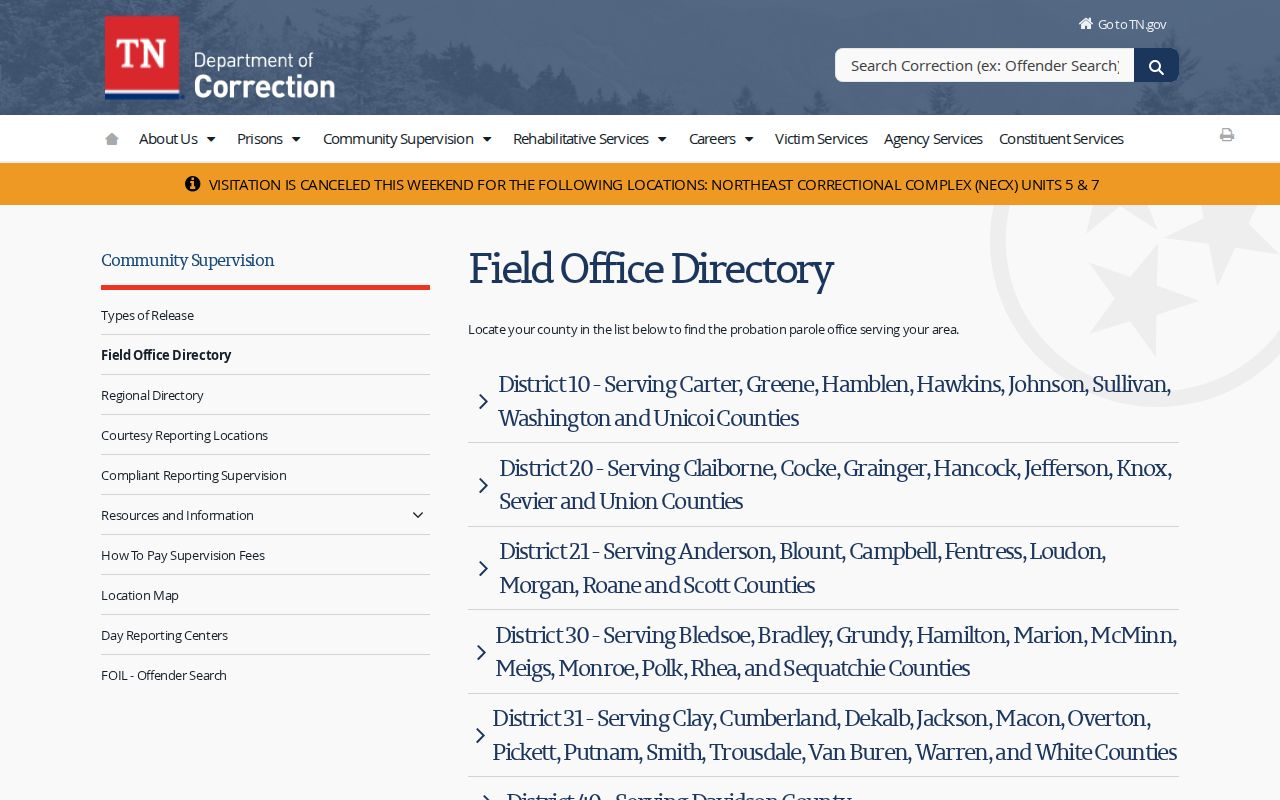
That directory is the routing source; the individual's FOIL record still controls which assigned location should be contacted.
Sumner County Parole Hearing Records
The Board publishes prospective hearing schedules, while FOIL supplies the practical public person-level Parole Hearing Result field. These records answer different questions. A schedule shows that a hearing is planned and can change. A result shows the reported outcome, but even a grant is not proof that staff completed a physical release. An effective date, approved plan, detainer, or later rescission may still intervene.
The official parole hearing schedules are updated weekly, normally Monday or Tuesday after a Monday holiday. Separate state-prison and county-jail schedule paths are offered, and last-minute changes can occur. Selected county-jail hearings permit virtual public attendance under the current instructions. For a formal decision that is not visible through FOIL, use the Board's public-records request channel.
The schedule landing page pictured here helps locate the correct hearing list for a Sumner County parole matter. Open the Board's live schedule page to check the current revision.
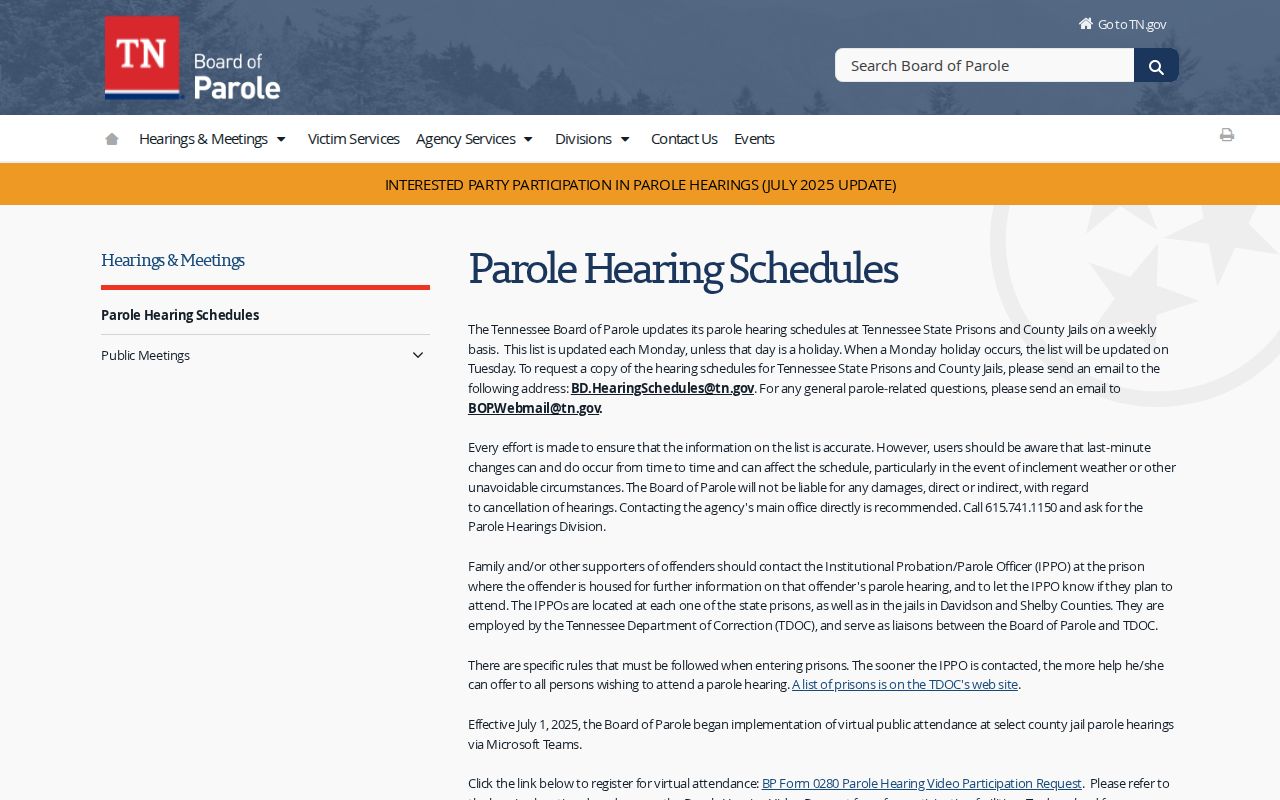
The schedule is evidence of a planned proceeding, not an accomplished release or an ended sentence.
Sumner County Supervision Conditions
Conditions come from the governing court order, Board action, and TDOC supervision plan. Common public records can establish the status and office, but they should not be stretched into claims about an individual's private schedule or services. A violation allegation can lead to a warrant, revocation process, added custody, reinstatement, or another official response. It is not a new conviction merely because it appears in supervision records.
The Board's hearing-type descriptions include preliminary and final revocation matters, custodial hearings, rescission, time-setting, and appeals. Hearing officers make nonbinding recommendations, while Board members may adopt, alter, or reject them. If a final decision is disputed, the published appeal process identifies limited grounds and deadlines. An appeal does not itself release the person.
Sumner County Warrants Are Separate
SCSO publishes warrant and Most Wanted information in the same official ecosystem as the inmate page. That can help explain why a person believed to be released is wanted again, but it is not a TDOC absconder list. A county warrant can arise from a local case. A TDOC violation warrant concerns supervision. One record cannot stand in for the other.
Check the SCSO warrant channel for its stated local purpose, then use FOIL, TDOC, or the Board record for supervision. Never approach a listed person. Direct an urgent safety concern or a tip to law enforcement through its official contact path.
Note: Absence from Sumner County's warrant page does not prove compliance with TDOC supervision or the formal discharge of a sentence.
Property After Sumner County Release
SCSO maintains a dedicated property channel, which matters when release processing and personal belongings need separate follow-up. Research found no published promise about pickup hours, required identification, proxy pickup, or a deadline. A released person or authorized representative should obtain current instructions before traveling rather than assume that intake or commissary rules describe release.
The SCSO Property page is the official starting point. If the release or supervision record itself is wrong, direct the correction to the creator of that record. SCSO handles its booking or release entry, the clerk handles a court docket, TDOC handles FOIL and sentence data, and the supplying agency handles a VINE event. Include the inmate or case identifier and the source document that shows the error.
Property acknowledgment can help document that discharge steps occurred. It does not replace a sheriff release sheet, FOIL status, or court order.
How Sumner County Supervision Ends
Release from jail or prison is not the same as discharge. A person on parole or probation remains under an active sentence until the governing authority ends that status. FOIL may later show Inactive, a past Sentence End Date, and no active Tennessee sentences. Read all rows together because an inactive label by itself can reflect several kinds of closure.
For firm proof, ask TDOC for the supervision-termination, discharge, or sentence-expiration document tied to the TDOC number. The archived-record channel can also provide a release authorization or computation when public fields are not enough. A filed court order may be needed for a probation change. The broader Sumner County released-inmate search explains how sheriff, court, FOIL, and VINE records can be reconciled for the same custody episode.
Use measured wording after review. “FOIL shows inactive supervision and no active Tennessee sentence” is narrower and more useful than a broad claim about all present legal obligations.