
Sumner County Three-Day Release Records
No distinct official Sumner County 72-hour release feed was identified. The SCSO Inmates page lists current booking cards, not a rolling history of jail exits. It provides no control for a three-day window and no promise that closed cards remain for 72 hours. The sound substitute is an existing jail release log or export limited by actual release timestamp, if SCSO maintains one, or the release record for each relevant booking.
A three-day request is broader than a same-day check. It can cover late-week events, a weekend, and the start of the next business day without assuming that the jail releases people early or on a fixed schedule. No official source verified Sumner County's weekend or holiday release practice. The selected timestamps must therefore be stated in the request, including the time zone, and the returned event type must be read literally.
Build a Sumner 72-Hour Window
Define the period before contacting the county. “The last three days” can shift while staff process a request. A fixed start and end time makes the scope clear and prevents booking dates from being confused with release dates. The current inmate page can help capture IDs for bookings seen during that span, but it cannot identify everyone who left.
- Choose fixed start and end timestamps covering the exact 72-hour period of interest.
- Record full names, inmate IDs, booking dates, and case numbers for known people. Do not rely on name alone.
- Call SCSO at 615-452-2616 for an urgent, person-specific custody check and ask whether the exit was release or transfer.
- Ask through the county public-records portal for any existing release log or report based on event timestamp.
- Verify material entries with VINE, the Sumner court portal, or TDOC FOIL according to the custodian involved.
For only the current day, use the Sumner County 24-Hour Releases workflow. It is narrower and better suited to one fresh event. The three-day method is designed for a bounded batch of official entries, not continuous monitoring.
Sumner 72-Hour Record Fields
No online SCSO table displays the fields below as a public release feed. The left column separates what the current card supplies from what an existing release log or episode record should be asked to supply. This keeps the date window tied to an exit event.
| Field | Use in a three-day check |
|---|---|
| Name and inmate ID | Match the person and booking episode; the current card shows these. |
| Booking date and time | Distinguishes episodes but does not place an exit inside the window. |
| Actual release date and time | The key event field for deciding whether an entry falls within 72 hours. |
| Release type or authority | Shows bond, order, sentence end, transfer, detainer pickup, or another basis. |
| Receiving agency | Separates community release from continued custody after transfer, when public. |
| Case or order reference | Connects the jail event with the legal authority in Sumner court records. |
SCSO's public cards also show image, race, sex, age, charges, and per-charge bond entries. Those are booking fields. A listed bond is not proof that it was posted, and a photograph is not proof of release. Ask for only the fields needed to answer the custody question.
Note: Use actual event time, since grouping records by booking date can omit people released during the selected period.
Sumner Weekend Release Checks
A 72-hour span can bridge days when public counters are closed, yet it does not reveal an unpublished jail schedule. Research found no official fixed daily release time, early-Friday rule, family waiting area, physical release gate, or holiday practice for Sumner County Jail. Do not infer one from another Tennessee county. Call the published SCSO number when current logistics matter.
The county portal states that a request submitted outside business hours is received the next business day. Its seven-business-day response language differs from the SCSO Records Division statement that many requests may take up to ten working days. Both should be kept in context. Neither says when a release entry is keyed into a jail system, nor does either guarantee completed production by that date.
VINE can help cover the gap between an event and the next records-office day. Search the exact person and confirm that Sumner County is the reporting agency. An alert signals a custody-status change, but SCSO remains the source for the official release type, exact processing time, and destination. For a named person across several systems, use the Sumner County released inmate search.
Request a Sumner Three-Day Log
Ask SCSO whether it already maintains a release log, export, or report for the fixed period. The Tennessee Public Records Act generally grants Tennessee citizens access to state and local records unless an exception applies, but it does not require a custodian to create a custom list. Inspection and copies are different. Copy and labor charges may apply, and SCSO may require proof of Tennessee citizenship.
A useful request asks for “any existing jail release log or report whose event timestamp falls from [start] through [end].” Add that electronic copies are preferred, and seek a fee estimate before staff begin chargeable work. If no aggregate record exists, narrow the request to episode-specific booking-and-release records. Ask for redaction of exempt material and production of the remaining public parts.
Sumner County Public Records Request CoordinatorOffice of Law Director
355 North Belvedere Drive
Gallatin, TN 37066
615-451-6060
PRR@sumnercountytn.gov
The coordinator can route a sheriff custody-record request when the web form is unclear. No exact sheriff per-page, photo, or labor fee was verified in the official materials, so ask for the current schedule rather than estimating it.
Sumner Roster Retention Limits
Sumner's current inmate cards are rich in booking detail and weak as historical evidence. They include name, inmate ID, booking timestamp, charges, bond, and a photograph. They do not include an actual release time, release reason, destination, or a released marker. No SCSO source promises real-time updating, a set refresh interval, or any period during which closed cards remain visible.
Preserve an inmate ID and booking date before removal. Later, phrase a web observation as “the card was absent when checked,” then seek an affirmative record. The strongest county evidence is the release sheet or log entry. The Sumner court judgment or bond order can explain the authority. VINE can corroborate the change. FOIL can reveal a state transfer or community-supervision status. Each source answers a different part of the event.
The official Sumner inmate page capture below shows the current-card format that was available during research.
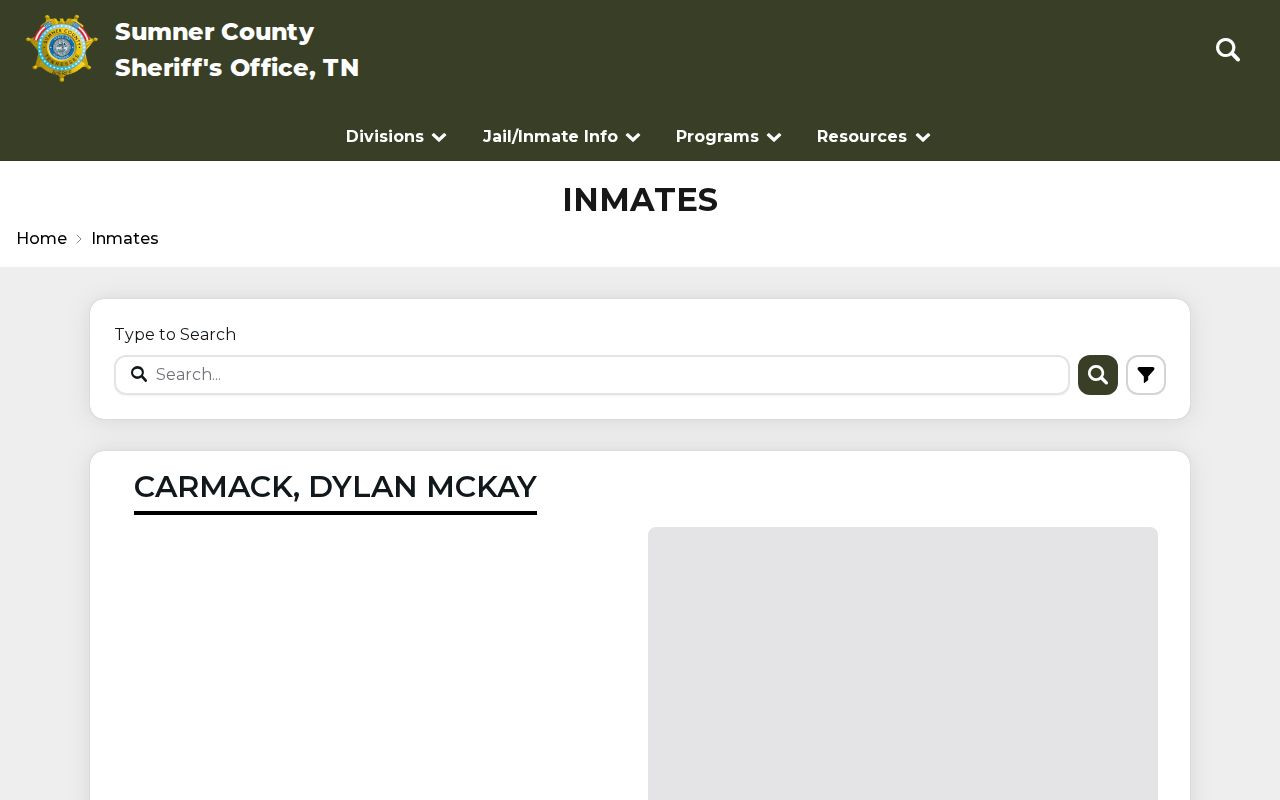
Its booking-focused layout supports a present-custody check, not a claim that removed cards remain visible through a three-day release window.
Note: A current-card screenshot has value only for the time captured; it does not establish the next custody event.
Sumner Releases Versus Transfers
Every entry in a requested three-day log must be read for outcome. Bond, recognizance, time served, sentence expiration, or probation may lead to the community. A transfer to TDOC, another county, a federal custodian, or ICE ends the Sumner booking while custody continues. “Released to detainer” is not community release.
Search TDOC FOIL when a felony sentence, parole, probation, or state transfer is possible. “Incarcerated” indicates custody. “Parole” and “probation” are community supervision, not full sentence discharge. An inactive record with past sentence information may support an ended state episode, but an exact release document may still require a TDOC archive request.
Federal cases use the BOP locator, and an immigration transfer uses ICE's locator. The Sumner court portal may show the judgment or order that authorized local release, though it does not necessarily record when the jail door event occurred. A careful three-day list thus states the SCSO episode, event time, and exit type without claiming more than the source proves.
When records conflict, ask the agency that created the disputed field. SCSO controls its release entry, the clerk controls the filed order, and TDOC controls FOIL data.
Keep the requested date range with the final record. That small step shows why the entry belongs in the three-day set and makes a later correction much easier to trace.